Getting a PhD as a Part-time Student
(This article is a republication of an article originally posted on September 20, 2017.) (Added on December 3, 2021: I participated in the “Acaric Advent Calendar 2021”.)
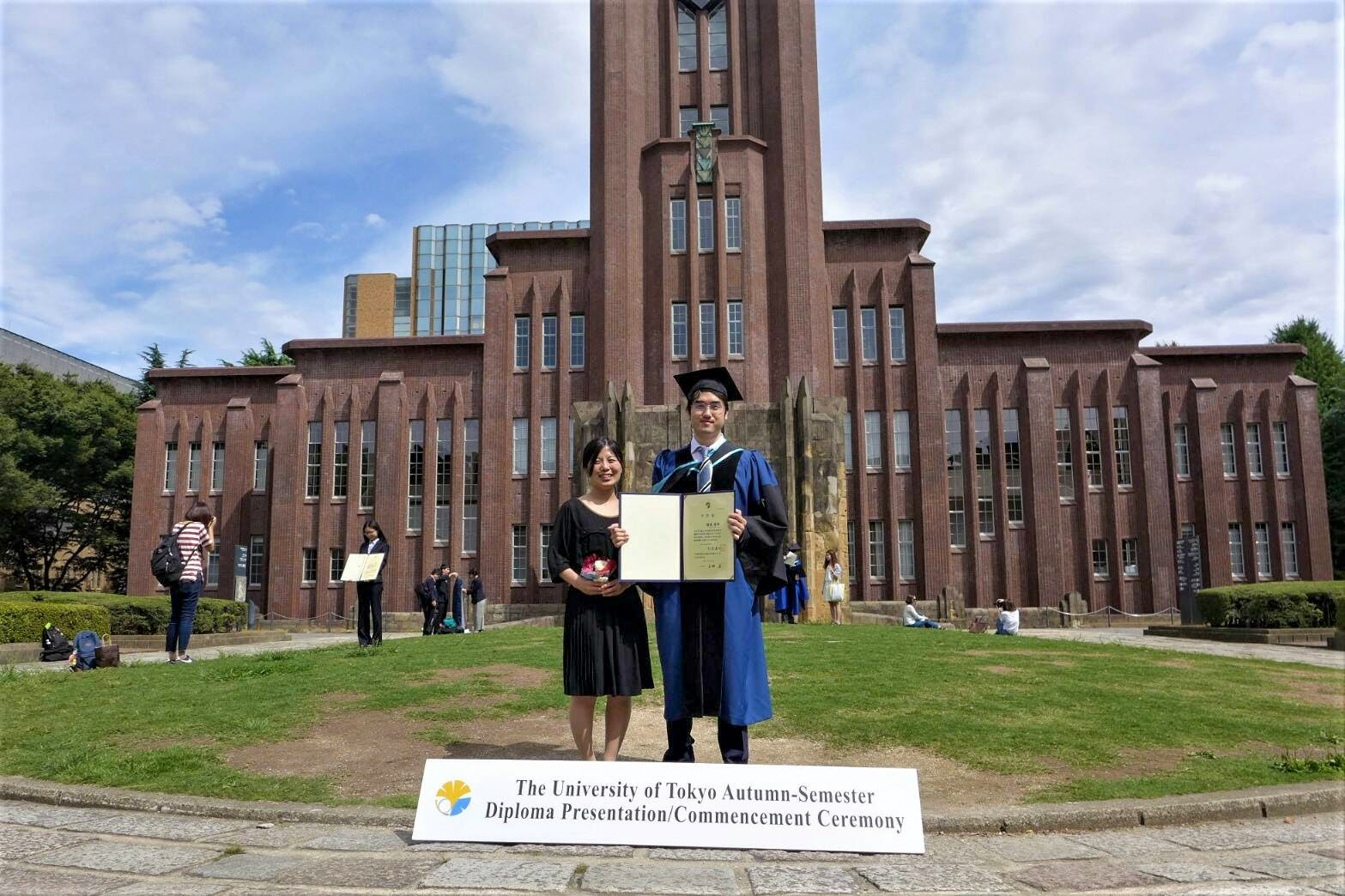
Yesterday, having completed the degree conferment ceremony, I successfully obtained my Doctor of Philosophy (Engineering) degree. As a part-time doctoral student, I engaged in research while commuting to the university for three years while working at a web-related company. Many people have already written about the life of a part-time PhD student, but I’d like to document my experience for those interested in getting a degree after becoming a working adult. Here, I will write under the premise of a course doctorate (not a dissertation doctorate) and research in the field of computer science.
What it takes to get a PhD
On the surface, the things you need to do to get a PhD (whether you are a working adult or not) are:
- Attend lectures and earn the required credits.
- Achieve the required research output.
- Compile those achievements into a doctoral dissertation.
These are the three main things. A doctoral program is primarily a place to do research, but you also need to attend lectures and earn a certain number of credits. As for your main research, while the specific number of papers required varies by university and graduate school, you must achieve a target number of research outputs. “Outputs” here refer to having papers accepted by journals or presenting at peer-reviewed international conferences. In my graduate school, three accepted journal papers were the general benchmark. And at the very end of the doctoral program, you must compile your research into a format known as a doctoral dissertation.
Attending lectures
Even as a part-time PhD student, you must physically attend classes at the university, take exams, and write reports. Depending on the university or graduate school, some classes are held on Saturdays, and some have no exams but only report assignments. You will choose such classes to earn the necessary credits. Some universities also support e-learning, providing a system where you can take classes without physically attending. In the graduate school I belong to, the condition was to acquire 10 credits (about 5 courses) separate from the doctoral dissertation. Fortunately, the 6th period at my university started at 18:30, which was a time I could make even after work, so I intensively took 6th period classes. In my case, I earned the required credits in the first year (2 semesters). Working as a web engineer, I was grateful that I could relatively freely control my working hours, except right before work deadlines.
Achieving research output
Survey, discuss, experiment, and write papers. These are the basics of doing research, but repeating this process endlessly to produce research outputs is the core of a doctoral program. For surveys, you can find most papers by connecting to the university server via a proxy and using Google Scholar or the ACM Digital Library. You can have discussions by throwing questions into the lab’s Slack or via VC (video conference). You can conduct experiments by writing programs on your laptop or the university server, and you can write and submit papers as long as you have a text editor. In other words, you can work anywhere, so the key is how much time you can carve out.
For a part-time PhD student, weekdays are primarily devoted to your main job, so weekday mornings/nights and weekends become your main research time. Building the habit of advancing your research during these times might be the first challenge. In my case, I went to the office early and dedicated 8:00-10:30 and the time after work to research on weekdays. Since it’s hard to secure large chunks of research time on weekdays, you have to advance your work bit by bit in these fragmented times.
Some might think, “Writing requires brainpower; you can’t make progress on a manuscript without a solid chunk of time.” However, in reality, there are many simple tasks like formatting figures and tables or explaining existing methods, so you can actually make quite a bit of progress.
“Three hours a day will produce as much as a man ought to write.” (Trollope, 1883)
This is a quote introduced in “The Productive Researcher’s Guide to Writing Papers: How to Write ‘A Lot’”, which makes you realize the power of writing habits.
Writing a doctoral dissertation
This is the final hurdle of the doctoral program. In your doctoral dissertation, you must summarize all your past research under one consistent theme. The idea is that there is a statement you want to assert regarding the target theme, and you arrange your past research to support it. In other words, you build a massive logic tree with your assertion at the top. For example, let’s say your main assertion is “B is effective for A.” Then you would argue, “B being effective means that properties C, D, and E can be verified,” and you place the individual studies that demonstrate properties C, D, and E. These individual studies correspond to your past research content.
Of course, it’s difficult to completely build this logic tree when you first enter the doctoral program. As you actually proceed with your research, you might find out things like, “Actually, C and D are fundamentally the same, and E is on a different layer.” In other words, this logic tree changes constantly as you advance your research. Therefore, the logic tree you set up at the beginning is merely a temporary guide for advancing your research, and you don’t need to be bound by it. When it comes time to write your dissertation, you just need to draw the cleanest logic tree you can at that point and write according to it.
For general paper writing, not just doctoral dissertations, this document is excellent, so please use it as a reference: Matsuo Gumi’s Guide to Writing Papers
Conclusion
Above, I have summarized how to write a doctoral dissertation based on what I felt throughout my doctoral course. When you write it down, what you have to do is simple, but I feel that making it a habit and proceeding quietly is the most important and difficult part. If I were to summarize what I learned through the doctoral program in one word, it would be that I slightly understood what it means to think. I believe research is an activity that advances human knowledge one step further by presenting a new way of seeing things that hasn’t existed before and verifying it. A new perspective can never be gained just by reading books. (If it’s written in a book to begin with, it’s not new.) Amidst this, dialoguing with yourself to find new structures. If you don’t have the material for that, reading books and papers, and then repeating the dialogue. Through this, I was able to learn the attitude of thinking about things. I think this is the greatest asset I gained from the doctoral program. I don’t know if I will build a career as a researcher from here on, but I believe that acquiring the tool of self-expression called writing a paper is a lifelong asset. Going forward, not just through papers, but through web services, open source, and various other forms, I hope to contribute to human knowledge and a more convenient life for humanity.